Altified vs Weglot: a Next.js SDK or a hosted website translator?
Compare how Altified and Weglot handle setup, translated URLs, hreflang, metadata, translation editing, and pricing, and see where each one is the better fit.
/ The short answer
Altified is an SDK you install in a Next.js App Router project: your app keeps rendering every language, while the SDK supplies translations, locale routes, and metadata. Weglot is a hosted website translation service that works with dozens of CMS platforms and site builders and can serve translated pages on subdomains or subdirectories without code changes. If your site runs on WordPress, Shopify, Webflow, or a similar platform, Weglot supports it and Altified does not.
On this page
Altified vs Weglot at a glance
| Capability | Altified | Weglot |
|---|---|---|
| Product type | SDK plus dashboard. The @altified/next package runs inside your Next.js app; the dashboard manages languages, translations, glossary, and the language switcher. | Hosted translation service with a dashboard, visual editor, glossary, and translation exclusions. |
| Supported platforms | Next.js App Router (Next.js 15 or newer). A separate Django SDK translates configured model fields. There are no WordPress, Shopify, or site-builder plugins. | WordPress, Shopify, Webflow, Squarespace, Wix, and many more listed integrations, plus a JavaScript snippet for any website. |
| Setup method | Install @altified/next and run altified init. It wraps your Next config, adds a locale-routing proxy file, and adds a sitemap of translated URLs. A developer reviews and deploys the change. | Install a platform plugin or app, or point language subdomains to Weglot with DNS records. Most supported platforms need no code changes. |
| Translation workflow | Machine translation through Google Cloud Translation, with glossary rules and protected terms. Review, edit, and lock translations in the dashboard. There is no in-page visual editor and no human-translation ordering. | AI translation with manual editing, a visual editor, and glossary. The pricing page lists access to professional translators from the Business plan. |
| URL structure | Locale-prefixed paths such as /fr/pricing, rendered by your own Next.js app. The default language can stay unprefixed. | Subdomains (fr.example.com) or subdirectories (example.com/fr/). Translated URL slugs are listed from the Pro plan, top-level domains from Extended. |
| Métadonnées et hreflang | Les métadonnées statiques exportées sont traduites automatiquement. Des fonctions d'assistance génèrent des URL canoniques autoréférentielles et des alternatives hreflang réciproques, que vous pouvez examiner dans votre propre code HTML. | Le centre d'aide de Weglot indique que ses intégrations de sous-domaines et de sous-répertoires ajoutent des balises hreflang et affichent les traductions côté serveur. Il précise également que l'intégration de l'extrait de code JavaScript n'apporte aucun avantage en matière de référencement, car les traductions sont affichées dans le navigateur. |
| effort du développeur | Nécessite un développeur. Le texte JSX littéral et le code source sont traduits automatiquement ; les valeurs de la base de données et de l’API doivent être traduites explicitement par clé ou par champ. | Le nombre de plateformes prises en charge est limité. Un développeur est principalement nécessaire pour les sites personnalisés, les enregistrements DNS ou un proxy inverse personnalisé. |
| Modèle de tarification | À partir de 29 $/mois pour 50 000 mots par mois et 2 langues cibles, jusqu’à 199 $/mois pour 1 million de mots et 20 langues. Essai gratuit de 14 jours avec 5 000 mots ; pas de formule gratuite. | Des forfaits en fonction du nombre total de mots et de langues traduites, à partir de 15 €/mois, plus un forfait gratuit pour un maximum de 2 000 mots et une langue. |
| Contrôles SEO | Les routes, les URL canoniques, les règles noindex, les sitemaps et les données structurées restent dans votre code, ce qui permet de les examiner et de les tester comme n'importe quelle autre modification. | Le comportement SEO est configuré dans Weglot et appliqué par son intégration. La version Enterprise utilise un proxy inverse personnalisé. |
Le choix approprié dépend de l'emplacement de votre contenu, de son mode de diffusion et du niveau de contrôle dont votre équipe a besoin sur l'expérience localisée.
Who each product is for
Weglot is built for website owners and marketing teams. Its strength is breadth: a long list of platform integrations, a visual editor that non-developers can use, and a setup that usually ends with a plugin or a few DNS records. Small sites can start on the free plan.
Altified is built for developers working in Next.js. It suits teams who already treat the website as an application: pages are rendered by their own server, content may come from a database or API, and SEO tags are expected to live in code review alongside everything else.
How a translated page reaches the visitor
With Weglot's subdomain integration, you add DNS records so that language subdomains are served through Weglot, which returns the translated HTML. With the subdirectory option, Weglot also manages hreflang on the original version. Either way, Weglot sits in the path between visitors and the translated page.
With Altified, a request for /fr/pricing reaches your own Next.js deployment. The proxy file resolves the locale, your server components render the page, and the SDK fetches the French copy from Altified using a server-side secret. If the translation service is unavailable, the source text is rendered instead, so the page still loads.
- Altified translates literal JSX text and copy written in your source automatically, the first time a page renders in each language.
- Altified does not translate database or API values automatically. You translate them by stable key or by configured Django field, which avoids changing IDs, prices, slugs, or user content by mistake.
- Weglot detects and translates the content it receives for the page, which is convenient when content comes from a CMS you do not control in code.
/ Pricing
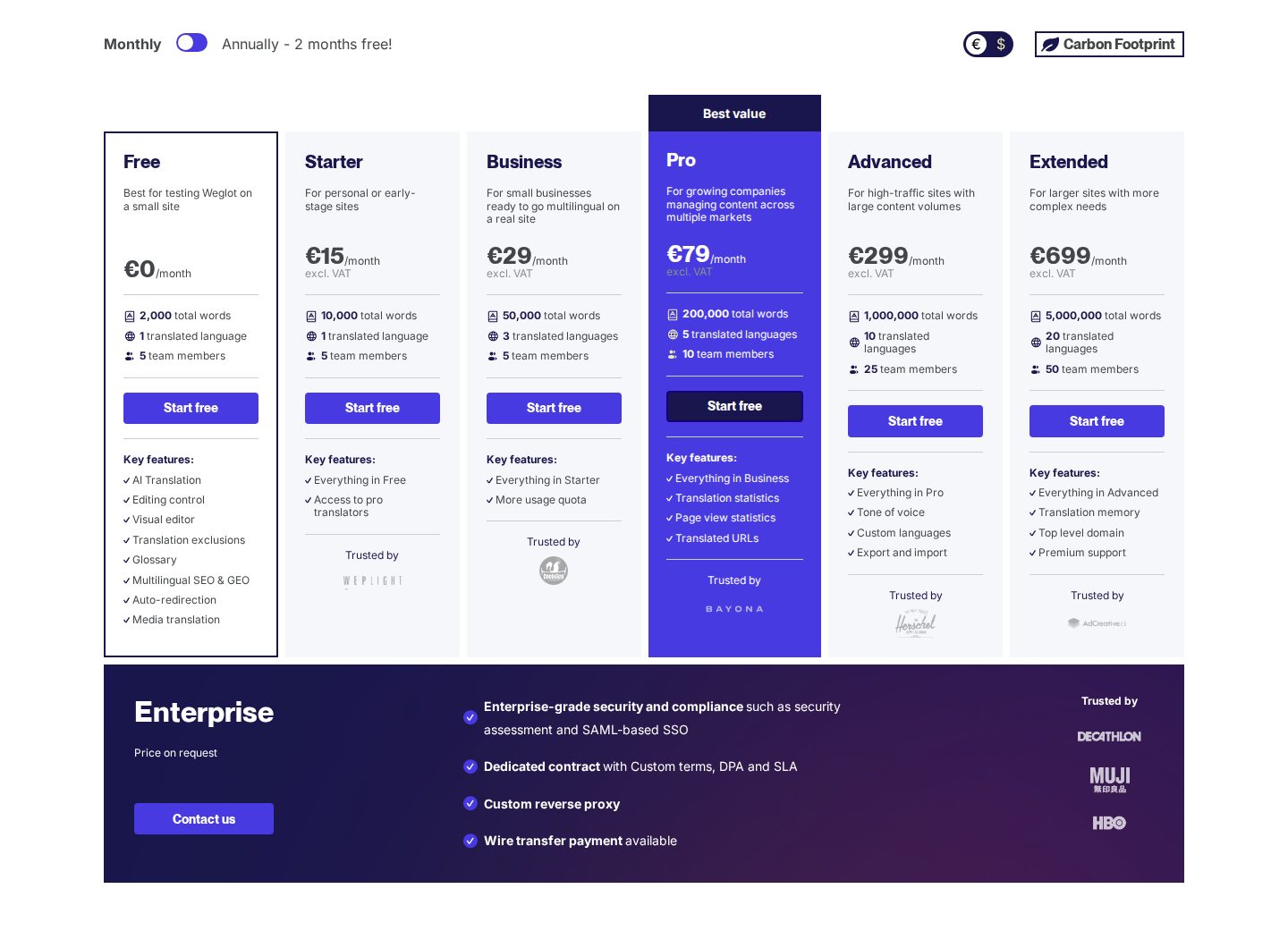
Weglot and Altified pricing
Checked on on each vendor's official pricing page. Prices exclude taxes and change over time, so confirm them before you buy.
| Plan | Monthly price (excl. VAT) | Includes |
|---|---|---|
| Free | €0 | 2,000 words, 1 translated language |
| Starter | €15 (about $17) | 10,000 words, 1 translated language |
| Business | €29 (about $32) | 50,000 words, 3 translated languages |
| Pro | €79 (about $87) | 200,000 words, 5 translated languages, translated URLs |
| Advanced | €299 (about $329) | 1,000,000 words, 10 translated languages |
| Extended | €699 (about $769) | 5,000,000 words, 20 translated languages, top-level domains |
| Enterprise | Sur demande | Authentification unique SAML, contrat personnalisé, DPA et SLA, proxy inverse personnalisé |
- Weglot facture en euros. Les montants en dollars américains sont des estimations affichées par Weglot sur sa page de tarification et dépendent du taux de change en vigueur à la date de votre abonnement.
- Les abonnements payants comprennent un essai gratuit de 14 jours. La facturation annuelle donne droit à deux mois gratuits.
- Les limites de Weglot correspondent au nombre total de mots traduits dans toutes les langues, et non à un quota mensuel.
- Source: Weglot pricing
| Plan | prix mensuel | Comprend |
|---|---|---|
| Démarreur | $29 | 50k words per month, up to 2 target languages |
| Croissance | $59 | 150k words per month, up to 5 target languages |
| Pro | $99 | 350k words per month, up to 10 target languages |
| Entreprise | $199 | 1M words per month, up to 20 target languages |
- Chaque forfait comprend une période d'essai de 14 jours incluant 5 000 mots et un projet. Il n'existe pas de forfait gratuit.
- Un seul abonnement couvre tous vos projets.
- Source: Altified tarification
Le nombre de mots n'est pas directement comparable. Weglot comptabilise le nombre total de mots dans vos langues traduites. Altified comptabilise les mots traduits par mois.
/ Best fit
Which one fits your site?
When Altified may be the better fit
- You build with the Next.js App Router and want every language rendered by your own deployment.
- Translated pages depend on database or API content that you want to translate field by field.
- You want canonical URLs, hreflang, and sitemaps generated in code and reviewed like other changes.
- You run several projects and want one subscription to cover them all.
When Weglot may be the better fit
- Your site runs on WordPress, Shopify, Webflow, Wix, Squarespace, or another platform Weglot integrates with.
- No developer is available to install and maintain an SDK.
- A small site fits within the free plan (2,000 words and one language).
- Editors need a visual, in-page editor or want to order professional translation.
- You want languages on separate top-level domains.
/ What this means for your stack
Start with your platform, then your SEO requirements.
If your website is built on a CMS or site builder, Weglot supports it and Altified does not, so the comparison ends there. If your website is a Next.js App Router application, both can produce indexable language URLs, and the choice comes down to where you want the translated page to be assembled.
Weglot keeps translation outside your codebase, which reduces developer work. Altified keeps translation inside it, which takes more developer work but lets your team see, test, and roll back routes, metadata, and dynamic content in the same repository.
/ Where Altified fits
Keep translation connected to the application that serves it.
Altified is the better fit when localized pages need to be rendered by your own frontend and backend, with dynamic records, application routes, and search metadata in the same delivery model.
/ Frequently asked questions
Questions teams ask before choosing a localization stack.
Does Weglot work with Next.js?
Weglot lists a JavaScript snippet that works on any website, plus a custom-code option. Its help center states that the JavaScript integration alone offers no SEO benefit because translations render client-side; subdomain or subdirectory integrations are needed for indexable language URLs. We did not find a Next.js-specific integration on Weglot's integrations page.
Does Altified have a free plan like Weglot?
No. Altified offers a 14-day trial with 5,000 words and one project. Paid plans start at $29 per month. Weglot has a free plan for sites with up to 2,000 words and one translated language.
Can Altified translate a WordPress or Shopify site?
No. Altified currently integrates with Next.js App Router applications, plus a Django SDK for model fields. For WordPress or Shopify, a hosted service such as Weglot is the more direct option.
Does Altified translate everything on the page automatically?
Not everything. Literal JSX text and copy written in your source files are translated automatically. Values from your database or APIs are translated explicitly by key or field, so data such as IDs, prices, and user content is never changed by accident.
Sources
Competitor details come from each vendor's official website, Checked on . Altified details come from its documentation and pricing page. Products change, so confirm anything that affects your decision with the vendor.
Continuez à comparer
Examinez les alternatives dans leur contexte.
Alternatives à Weglot
Comparez plusieurs alternatives à Weglot selon leur approche, leurs URL SEO et leur prix.
ExplorerAltified vs ConveyThis
Un autre service de traduction hébergé avec une formule gratuite et plusieurs niveaux de prix.
ExplorerInstallez le SDK Next.js
Ajoutez Altified à un projet Next.js App Router et exécutez l'initialiseur.
ExplorerConfiguration SEO multilingue
Configurez les routes locales, les métadonnées, les balises hreflang et le plan du site des URL traduites.
ExplorerAltified tarification
Abonnements mensuels par mots et langues cibles, avec un essai gratuit de 14 jours.
ExplorerWeglot pricing
Chaque plan Weglot, la méthode de comptage des mots et des exemples de coûts.
Explorer